
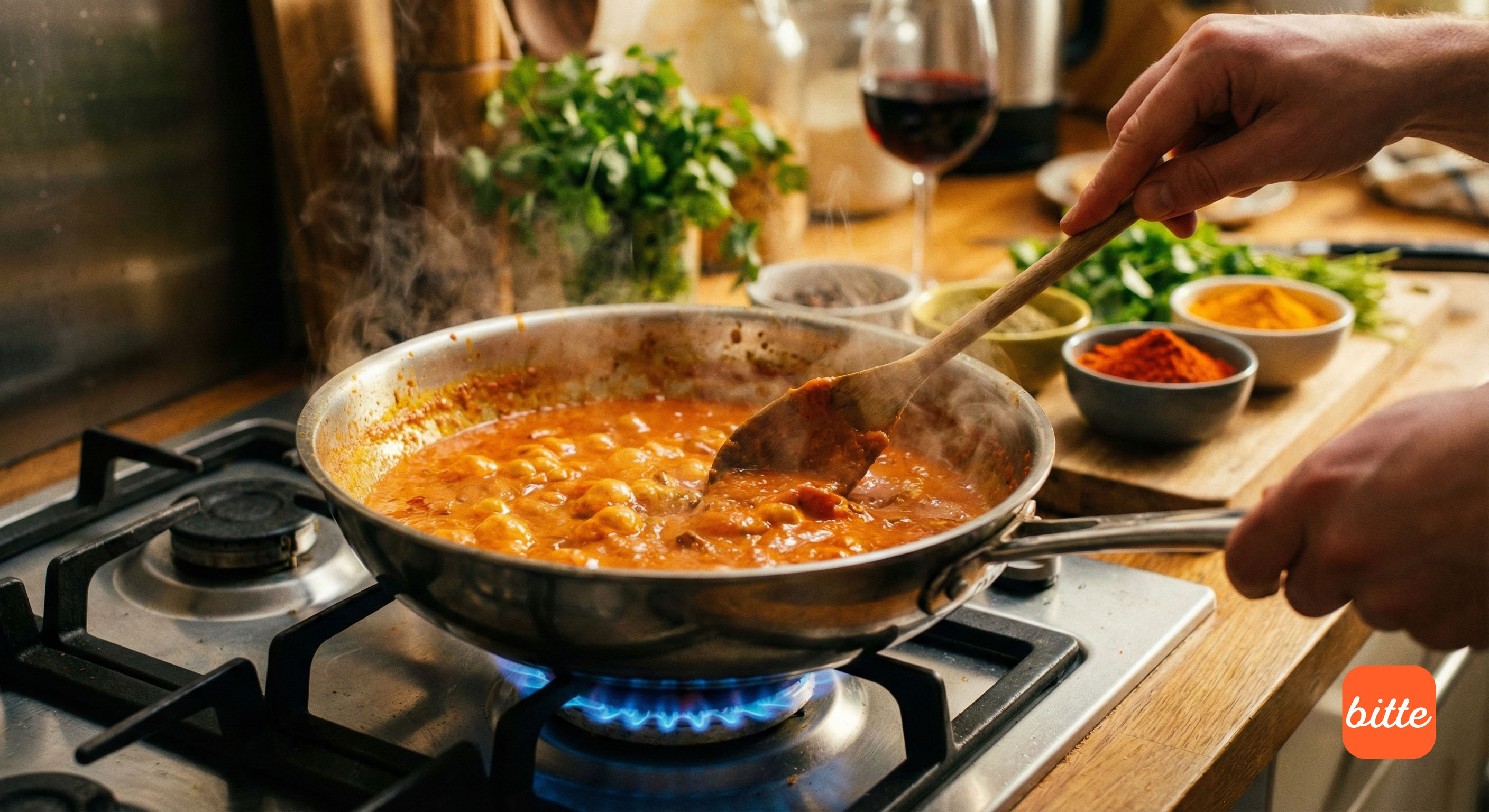
We have all been there. It’s 7 PM on a Friday. The craving hits you. You want a Chicken Tikka Masala, a Lamb Bhuna, or a spicy Madras. But you’re trying to save a few quid, or maybe you just feel inspired to cook.
So, you head to the supermarket, buy a jar of "Premium Tikka Sauce," some chicken breasts, and a bag of rice. You go home, follow the instructions on the jar, and sit down to eat.
And then… disappointment.
It’s fine. It’s edible. But it’s not that. It doesn’t have that rich, velvety texture. It lacks that smokey depth. It doesn’t glisten with that tempting layer of oil. It tastes like… well, stew.
Why is there such a massive gap between the curry you cook at home and the curry that arrives at your door from your favourite local Indian takeaway?
At Bitte.uk, we are obsessed with great food. While we are busy building a platform to deliver that food to you fairly, we also want to help you understand what makes it so special. Today, we are unlocking the secrets of the British Indian Restaurant (BIR) kitchen.
Put down the jar sauce. Here is how you actually make a restaurant-quality curry at home.
The Secret is Not in the Jar (It’s in the Gravy)
The first thing to understand is that the food served in Indian restaurants in the UK is a cuisine of its own. It evolved specifically to serve customers quickly. A chef cannot start chopping onions and slow-cooking a sauce for every single order of Rogan Josh that comes into the kitchen.
Instead, they use a master key: The Base Gravy.
If you walk into any Indian takeaway kitchen in Manchester, London, or Birmingham, you will see a massive pot simmering on the stove. This pot contains the "Base Gravy" (or Garabi). It is a thin, soup-like sauce made from boiling huge amounts of onions, garlic, ginger, water, and mild spices until they completely disintegrate.
This neutral sauce is the canvas. Whether you order a Korma or a Vindaloo, the chef starts with this same base gravy. The difference lies in what they add to it in the final pan.
Tip #1: To replicate this at home, you cannot just chop an onion and fry it. You need to make a batch of Base Gravy. It involves boiling onions for an hour and blending them until smooth. It’s an effort, but it’s the only way to get that "velvety" texture.
Don’t Fear the Oil (and the Heat)
Health consciousness is great, but it is the enemy of the authentic takeaway taste.
If you watch a takeaway chef in action, you will notice two things:
The flame under the pan is like a jet engine.
They use more oil than you think is "reasonable."
The technique involves heating oil until it is shimmering hot, then throwing in spices. This process, called "blooming" or making a Tarka, releases essential oils from the spices that simply boiling them won't achieve.
When the base gravy hits that super-heated oil, it sizzles, caramelises, and emulsifies. That separation you see in a good curry—where the red oil floats on top—is a sign of quality cooking. It carries the flavour.
Tip #2: Turn your extractor fan on max. You need high heat. If you aren't coughing slightly from the chili fumes, you aren't doing it right!
The Magic Herb: Kasuri Methi
Have you ever smelled a curry and instantly known it was from a restaurant, even with your eyes closed? That distinctive, slightly sweet, maple-syrup-like aroma?
That is Kasuri Methi (Dried Fenugreek Leaves).
It is the unsung hero of British Indian cuisine. Home cooks often skip it because it’s not always in the "Basics" aisle at Tesco. But without it, your curry will always taste one-dimensional. It is usually added towards the end of the cooking process, rubbed between the palms of the hands to release the aroma.
Tip #3: Buy a box of dried fenugreek leaves from an Asian grocer. It will last you forever, and it is the closest thing to "magic powder" in the curry world.
The Step-by-Step "Fakeaway" Blueprint
Ready to try? You don't need a Tandoor oven, but you do need preparation. Here is the simplified workflow of a BIR chef:
1. Pre-cook your protein: Restaurants don't cook raw chicken in the sauce. They use pre-cooked, often marinated meat. For the best result, dice your chicken breast, marinate it in yoghurt and spices, and bake it in the oven until just cooked. Set it aside.
2. The Spice Mix: Mix your spice powder in a small bowl before you turn on the gas. Usually a mix of Curry Powder, Turmeric, Paprika, Cumin, and Chili Powder. You won't have time to measure while the pan is hot.
3. The Burn (Controlled): Heat 3 tablespoons of vegetable oil (or ghee) in a frying pan. Add garlic and ginger paste. Let it sizzle (don't burn it!). Add your tomato puree and your spice mix. Cook it out for 30 seconds. It will look like a dry, dark paste. This is where the flavour lives.
4. The Gravy: Add a ladle of your pre-made Base Gravy (or a very heavily blended onion soup if you are rushing). Turn the heat up high. Let the liquid reduce down until oil spots appear on the surface. Add another ladle. Repeat. This reduction concentrates the flavour.
5. The Finish: Add your pre-cooked chicken. Add your "finishing touches."
For Masala: Add coconut flour, almond powder, and single cream.
For Madras: Add lemon juice and extra chili powder.
For Bhuna: Add fresh chopped tomatoes and green peppers.
Sprinkle a generous pinch of Kasuri Methi and fresh coriander. Done.
The "Rice" Deal
You can’t serve a masterpiece curry with sticky, gloopy white rice. Takeaway rice (Pilau) looks multicoloured and the grains are separate.
The trick: Wash your Basmati rice until the water runs clear (at least 3 times) to remove starch.
The colour: That yellow/red colouring? It’s food colouring added to a few grains of cooked rice and then mixed back into the white rice.
The aroma: Cook your rice with a cinnamon stick, a few cardamom pods, and a clove for that aromatic shop smell.
Is It Worth the Effort?
Now, here is the reality check.
Making a proper BIR curry at home is incredibly satisfying. When you nail it, you feel like a wizard. But let’s be honest:
It creates a mountain of washing up.
Your kitchen will smell like onions for two days.
Making the Base Gravy takes hours of preparation.
You need to buy 15 different spices.
Sometimes, the "Fakeaway" is a fun weekend project. It’s a hobby.
But on a rainy Tuesday, or a tired Friday? Sometimes the best curry is the one you didn't have to cook.
Wait for the Real Deal
That is where Bitte.uk comes in.
We love home cooking (obviously, we just wrote 1000 words about it!). But we also know the value of a great local chef. There are thousands of independent Indian restaurants in the UK where families have been perfecting these exact recipes for generations.
When we launch, we want you to support those local legends.
We will offer lower commissions, meaning those chefs make more money to invest in better ingredients.
We will offer better prices for you, so ordering a takeaway doesn't feel like a guilty splurge.
So, by all means, try the recipe this weekend! Get messy, burn some spices, and enjoy the art of cooking.
But for all those other nights when you just want the magic delivered to your door without the washing up? We’ll be here soon.
Join the Bitte.uk Waiting List (Sign up now and tell us: What is your go-to curry order?)
Share