
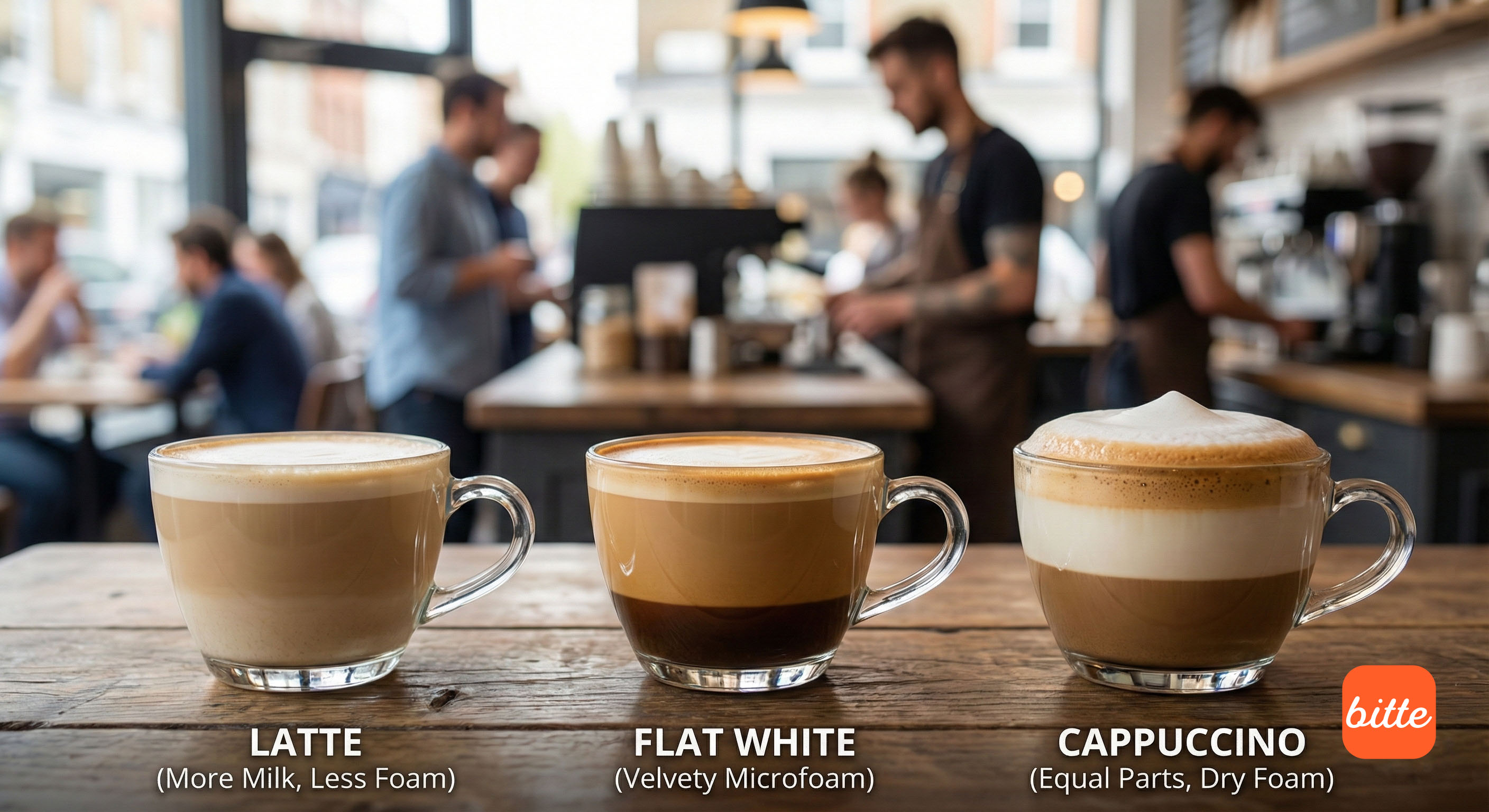
Once upon a time, asking for a coffee in the UK was simple. You had two choices: black or white. Usually, it was made from granules out of a tin, served in a chipped mug, and tasted vaguely of burnt toast.
Thankfully, those days are long gone.
Walk down any High Street in London, Manchester, or Edinburgh today, and you are greeted by the hiss of steam wands and the smell of freshly ground Arabica beans. The UK has officially become a nation of coffee snobs. We care about our roasts, our origins, and our brewing methods.
But with this revolution came a new language. The menu boards above the barista’s head have become increasingly complex. Cortado? Piccolo? Long Black? Magic? (Yes, that last one is real).
For the uninitiated, ordering a morning brew can feel like a pop quiz you haven't studied for. You panic, mumble "just a latte, please," and walk away wondering what that delicious-looking small drink the person next to you ordered was.
At Bitte.uk, we believe you should get exactly what you want. Whether you are ordering a delivery to your home office or visiting a local independent cafe, here is your essential guide to navigating the modern coffee menu.
The Foundation: The Espresso Shot
Before we talk about milk, we must talk about the heart of the operation: the Espresso.
Every drink on the menu starts here. An espresso is a concentrated "shot" of coffee, made by forcing pressurised hot water through finely-ground coffee beans.
Single Espresso: One shot (approx. 30ml). Intense, rich, and topped with a golden-brown foam called crema.
Double Espresso (Doppio): The standard in the UK. Most high-street coffees (Lattes, Flat Whites) are made with a double shot base for that caffeine kick.
Now, let’s add the milk and see what happens.
The Big Three: Latte, Cappuccino, Flat White
This is where the confusion usually lies. They all contain espresso and textured milk. So, what is the actual difference? It comes down to two things: Volume and Foam Texture.
1. The Latte (The Safe Haven)
The Vibe: Comforting, milky, gentle.
The Build: A double shot of espresso topped with a lot of steamed milk and a thin layer of foam (about 1cm).
The Taste: It is the mildest of the bunch. The high ratio of milk to coffee dilutes the bitterness of the espresso. It is essentially a coffee-flavoured milk drink.
Best for: A long, slow drink while reading a book.
2. The Cappuccino (The Classic)
The Vibe: Frothy, textural, old-school.
The Build: Traditionally, it is a rule of thirds: 1/3 espresso, 1/3 steamed milk, and 1/3 thick, bubbly foam.
The Distinctive Feature: The "Dome." A good cappuccino should have a domed head of foam that rises above the rim of the cup. In the UK, it is often dusted with chocolate powder (though purists will tell you this is a crime).
The Taste: You get a mouthful of air/foam before you hit the liquid. It feels lighter than a latte.
Best for: Those who like playing with their foam with a spoon.
3. The Flat White (The Cool Kid)
The Vibe: Sophisticated, strong, smooth.
The History: Originating from Australia and New Zealand, the Flat White arrived in London in the mid-2000s and conquered the nation.
The Build: A double shot of espresso (sometimes a Ristretto, which is a shorter, sweeter shot) topped with "microfoam."
The Secret: Microfoam is the key. It is milk steamed to have tiny, microscopic bubbles, creating a texture like wet paint or velvet. There is no stiff froth on top. It is smaller than a Latte (usually 6-8oz cup).
The Taste: Because there is less milk than a Latte, the coffee flavour is much stronger and punchier, but the texture is incredibly silky.
Best for: People who actually like the taste of coffee but want the creaminess of milk.
The Small & Mighty: Cortado, Piccolo, Macchiato
If you want to look like a true coffee aficionado, step away from the pint-sized mugs and try the smaller cups.
4. The Cortado (The Spanish Star)
The Ratio: 1:1. Equal parts espresso and steamed milk.
The Experience: Served in a small glass (never a mug). It cuts the acidity of the espresso without drowning it in milk. It is short, sharp, and balanced.
5. The Macchiato (The "Marked" One)
The Definition: "Macchiato" means "stained" or "marked" in Italian.
The Build: A shot of espresso with just a tiny dollop (a stain) of milk foam on top.
Warning: Do not confuse this with the "Caramel Macchiato" served at certain big chains, which is basically a vanilla milkshake with coffee added. A real Macchiato is a strong, bitter drink.
6. The Piccolo (The Baby Latte)
The Build: A Ristretto shot topped with warm silky milk, served in a 100ml glass.
The Taste: Intense. It is like a Flat White that has been shrunk in the wash.
The Black Sheep: Americano vs. Long Black
No milk? No problem. But even here, there is nuance.
7. The Americano
The Method: Espresso is poured into the cup first, and hot water is dumped on top.
The Result: The hot water breaks the crema (the golden foam), leaving you with a black coffee that looks similar to filter coffee.
8. The Long Black
The Method: Hot water is poured into the cup first, and the espresso is gently extracted on top of the water.
The Result: The crema remains intact on the surface. It looks better, smells better, and retains more of the aromatic oils.
The "Alternative" Revolution: Oat, Almond, Soy
We cannot talk about UK coffee culture without mentioning the milk alternatives. The days when "soy" was the only option are over.
Oat Milk: The current king of the UK coffee scene (thanks to brands like Oatly and Minor Figures). It creates the best microfoam and has a neutral, creamy taste that pairs perfectly with coffee.
Almond Milk: Nutty and thin. It can sometimes split in acidic coffee.
Coconut Milk: Delicious, but makes everything taste like a Bounty bar.
Pro Tip: If you are ordering a Flat White with plant-based milk, ask for Oat. It is the closest texture to dairy.
Why Local Coffee Tastes Better
You might wonder, "Does it really matter where I get my coffee?"
Yes. It does.
The big chains (you know the ones with green or red logos) prioritize consistency and speed. They often roast their beans very darkly to mask the quality of the green bean, resulting in a bitter, burnt taste that needs syrup and sugar to be palatable.
Independent local coffee shops—the ones we champion at Bitte.uk—usually serve "Specialty Grade" coffee. These beans are roasted lighter to highlight natural flavour notes like chocolate, berries, nuts, or citrus. The baristas are trained artisans who know exactly how to steam milk to get that velvet texture.
When you order a coffee from a local independent spot:
You get a superior caffeine fix.
You support a small business owner in your community.
You avoid the corporate "cookie-cutter" experience.
Bring the Cafe Home
Work-from-home culture is here to stay, and sometimes you just need that barista-quality Flat White to power you through a Zoom meeting, but you can’t leave the house.
This is where Bitte.uk steps in.
We are building a platform that connects you with the best independent cafes in your city. Not the big chains, but the hidden gems that roast their own beans and pour the perfect Rosetta art on your foam.
So, next time you open the app, be brave. Skip the Latte. Try a Flat White. Or if you are feeling dangerous, a Cortado.
Now that you speak the language, the menu is yours to explore.
Time for a coffee break? Join our waiting list to see which of your favourite local cafes will be delivering on Bitte.uk.
Join the Waitlist (Fun Fact: Did you know coffee stays hotter for 20% longer in a pre-warmed cup? Now you do!)
Share