
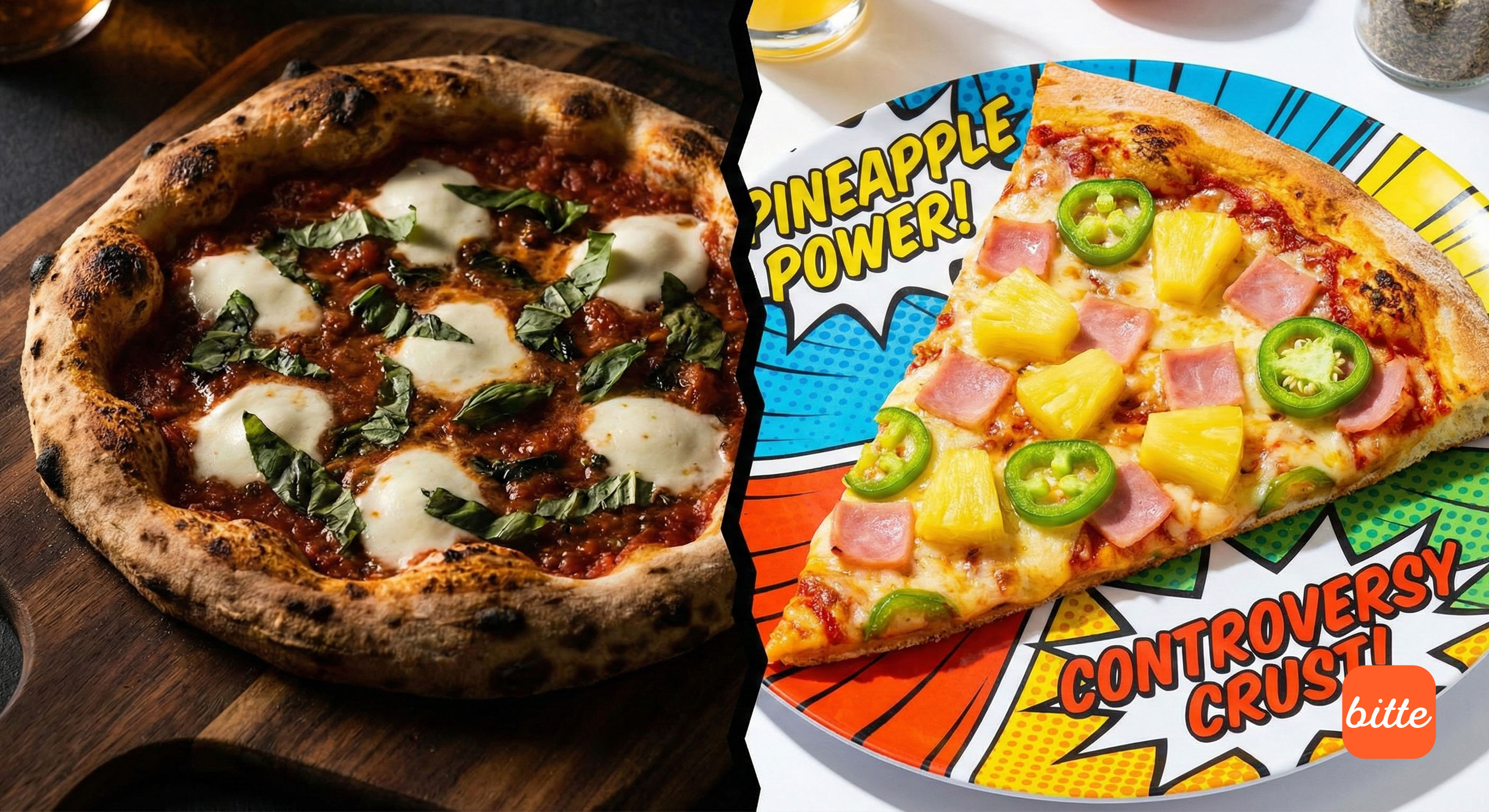
The Great Debate: Does Pineapple Really Belong on Pizza?
There are certain topics you should avoid discussing at a polite dinner party if you want to keep the peace: politics, religion, and… pineapple on pizza.
It sounds ridiculous, doesn't it? That a simple yellow fruit could cause such a divide in modern society. Yet, here we are. The debate over whether pineapple belongs on a pizza is the culinary equivalent of "Oasis vs. Blur" or "Cats vs. Dogs." It splits families, ends friendships, and causes intense arguments in takeaway shops across the UK every Friday night.
For some, the "Hawaiian" pizza is a sweet and savoury masterpiece, a perfect marriage of flavours. For others, particularly Italian purists, it is an abomination—a crime against dough, cheese, and tomato sauce.
At Bitte.uk, we are all about freedom of choice (and fair delivery fees), but today, we are putting on our referee shirts. We’re diving deep into the history, the science, and the controversy of the world’s most divisive topping.
So, grab a slice (of whatever you prefer), and let’s settle this once and for all.
Where Did It All Begin? (It Wasn’t Hawaii)
One of the biggest misconceptions about the Hawaiian pizza is its origin. If you thought this tropical delight was invented on the sunny beaches of Honolulu or Maui, you would be wrong.
It was actually invented in Ontario, Canada.
The year was 1962. A Greek-born restaurateur named Sam Panopoulos was experimenting with new toppings at his restaurant, the Satellite Restaurant. At the time, pizza was still a relatively new concept in North America, mostly limited to pepperoni and mushrooms. Panopoulos, inspired by the sweet and savoury contrasts found in Chinese dishes (which he also cooked), decided to throw some canned pineapple on a pizza just to see what would happen.
He named it "Hawaiian" simply because that was the brand of canned pineapple he used.
Initial reactions were… confused. But slowly, the combination of the sweet fruit and the salty ham began to catch on. It spread from Canada to the US, hopped across the pond to the UK, and eventually became a staple on menus worldwide.
So, the "Italian" pizza you are arguing about is actually a Greek invention, made in Canada, named after an American state. Talk about a global identity crisis!
The Case AGAINST: "It’s Just Wrong!"
Let’s start with the purists. The arguments against pineapple on pizza are usually loud, passionate, and often delivered with an Italian hand gesture.
1. The "Soggy" Factor From a technical culinary standpoint, pineapple is a risky topping. Fresh pineapple is packed with water. When you throw it into a scorching hot pizza oven, that water is released. If not managed correctly, this can lead to the dreaded "soggy bottom." Critics argue that a pizza should be crisp and firm, and adding a wet fruit compromises the structural integrity of the slice.
2. The Acidity Clash Tomato sauce is acidic. Pineapple is also acidic. Critics argue that doubling down on acidity throws the flavour profile off balance. They believe the sweetness of the fruit overpowers the delicate herbs in the sauce and the richness of the mozzarella.
3. "It’s Not Italian" This is the emotional argument. Pizza is an Italian invention, protected by tradition. In Naples, the birthplace of pizza, there are strict rules about what constitutes a "real" pizza (Pizza Napoletana). You won't find pineapple anywhere near a traditional menu in Rome or Florence. For many, putting fruit on pizza is seen as disrespectful to centuries of culinary tradition.
Even celebrity chef Gordon Ramsay famously stated: "You don't put pineapple on pizza." And when Gordon speaks, people tend to listen (mostly out of fear).
The Case FOR: A Symphony of Sweet and Salty
Now, let’s hear from the defenders. Despite the hate, the Hawaiian pizza consistently ranks in the top 3 most popular pizzas in the UK. Why do so many people love it?
1. The Science of Flavour The defenders have science on their side. The human palate loves contrast. The combination of sweet and salty is a proven winner in the culinary world. Think about salted caramel, maple syrup on bacon, or apple sauce with pork. The sweetness of the pineapple cuts through the saltiness of the ham (or bacon) and the richness of the cheese. It acts as a palate cleanser, making every bite feel fresh.
2. Texture When cooked properly, pineapple caramelises. The sugars break down, creating a slightly sticky, roasted texture that contrasts beautifully with the melted, gooey cheese and the crispy crust. It adds a "bite" that other toppings just don’t offer.
3. It’s Fun! Pizza is meant to be a comfort food, not a history lesson. The pro-pineapple camp argues that food should be about enjoyment, not rigid rules. If it tastes good, why does it matter if it’s traditional?
The World is Weirder Than You Think
If you think pineapple is controversial, you clearly haven’t seen what the rest of the world puts on pizza. Before you judge the Hawaiian lovers, consider these global toppings:
Sweden: One of the most popular pizzas in Sweden is the "Banana Curry Pizza." Yes, you read that right. Bananas, curry powder, and peanuts. Suddenly, pineapple seems quite normal, doesn't it?
Japan: "Mayo Jaga" pizza features mayonnaise, potatoes, and corn.
Australia: It’s not uncommon to find crocodile meat or kangaroo on a pizza down under.
Brazil: They treat pizza as a dessert, topping it with guava marmalade and cream cheese.
Compared to bananas and curry, a bit of pineapple is hardly the culinary crime of the century.
The UK Verdict: Where Do We Stand?
The United Kingdom is a nation of pizza lovers. We order millions of them every year. But are we Team Pineapple or Team No-Pineapple?
Recent surveys suggest that the UK is actually quite fond of the tropical topping. While the loud minority on Twitter (or X) screams about how terrible it is, the silent majority is quietly ordering Hawaiian pizzas on a Friday night.
Perhaps it’s our love for mixing sweet and savoury (we do put jam on meat, after all). Or maybe we just like to rebel against culinary snobbery.
The Bitte.uk Philosophy
At Bitte.uk, we have a strict policy: We Don’t Judge.
Whether you are a Margherita purist, a Pepperoni lover, or a die-hard Hawaiian fan, we believe you deserve the same thing:
Great food from local restaurants.
Delivered hot and fresh.
And most importantly, fair prices without hidden commissions.
We are building a platform where every taste is celebrated. When we launch, you’ll be able to order your controversial pineapple pizza (or your classic cheese pie) from the best local spots in your area, knowing that you aren't being ripped off by high fees.
Cast Your Vote!
The debate may never truly end, but we want to know where our future community stands.
Are you brave enough to admit you love it? Or do you believe it belongs in the bin?
Tell us on our social media channels! Tag us with your hottest pizza take. And remember, no matter what you like to eat, Bitte.uk will soon be here to deliver it fairly.
Hungry for more? Join our waiting list today. We promise not to send you a pineapple pizza unless you specifically ask for one!
Warning: No pineapples were harmed in the writing of this blog post. Though a few were eaten.
Share